
Episode 4 : Learning to Walk, Learning to Wonder
Oct 6th 2027: In a world that harvests anxiety for profit, one father plants seeds of wonder and wisdom in his daughter - preparing her for her destiny as a healer.
[If this is your first entry into this series, read episode 3 for full context]
Rajagiri College of Social Sciences, May 2024; Iladevi’s father waits in the library to visit her.
I last saw her in February, hunched over textbooks, worried about her Psychology exam. When I suggested she take a walk to let her mind breathe a little, she snapped at me: "Appa, you don't understand. This isn't some forest. I can't just go outside and expect answers to come to me." I sighed. This place creates stress instead of joy. In the forest, when we don't know, we become curious. Here, questions create anxiety. But, this is how the world works today - so I gave her space.
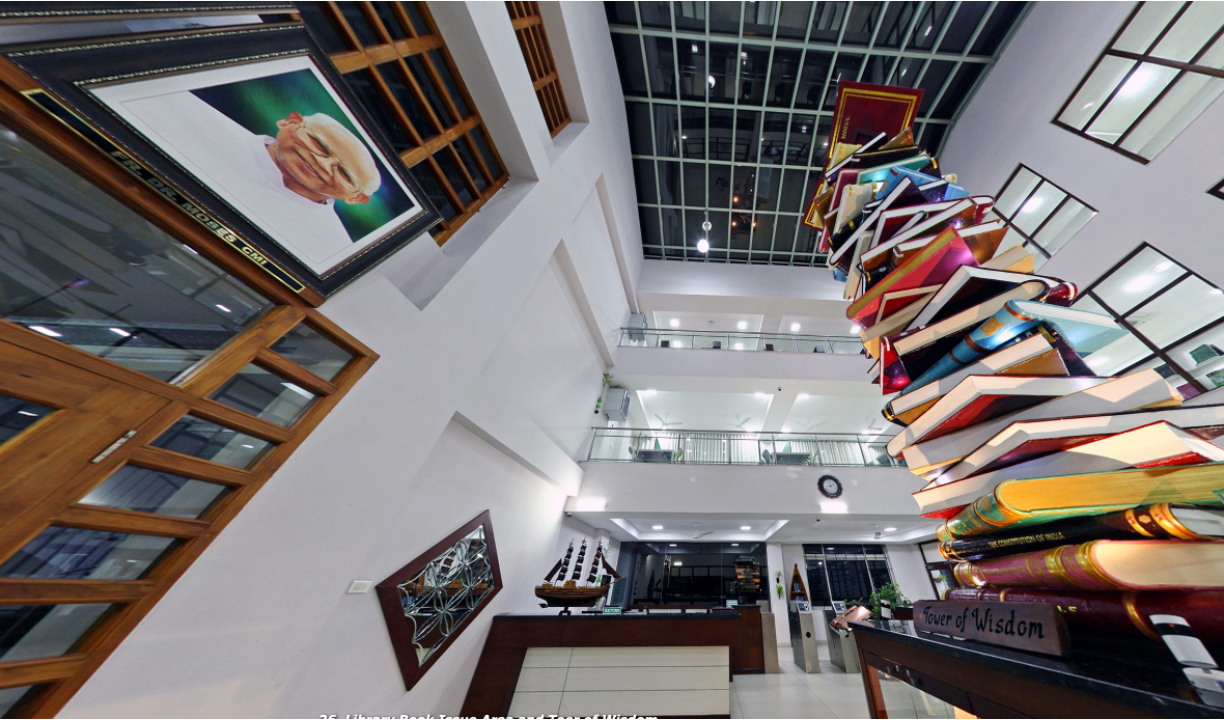
I entered the library, clutching a bag of mangoes I plucked from our tree in Wayanad. Maybe a taste of home will calm her nerves today.
The library is modern, impressive, imposing - made to make one feel small. In the center rises the multi-story "Tower of Wisdom" sculpture - books stacked in a spiral that climbs toward the ceiling, with an open Bible at the top. The message was clear - “wisdom is in books; it’s hierarchical; it’s exclusive”.
In the living world, wisdom flows through roots, connecting every living and non-living thing. It moves with seasons, speaks through bird calls, embeds in grandmothers' comforting touch and the artisan's deft fingers. Wisdom isn’t written down but experienced. We don't learn about wisdom—we uncover it within ourselves as part of the conversation between our body, earth, water and sky.
But in their manufactured world, wisdom is in separation and competition. Oblivious to the web of life, their notion of wisdom sees most of life as soulless machines to be exploited.
I catch my own reflection in the glass door; my diminutive frame in front of this monument. It looked down on me - like all those who looked down on my people. We were scorned as untouchables by the caste system; recruited to the front lines by freedom fighters and the British alike; patronized by missionaries as dumb savages.
Yet here we still are. We've survived at the edge of extinction for far longer than the fictions in these books.
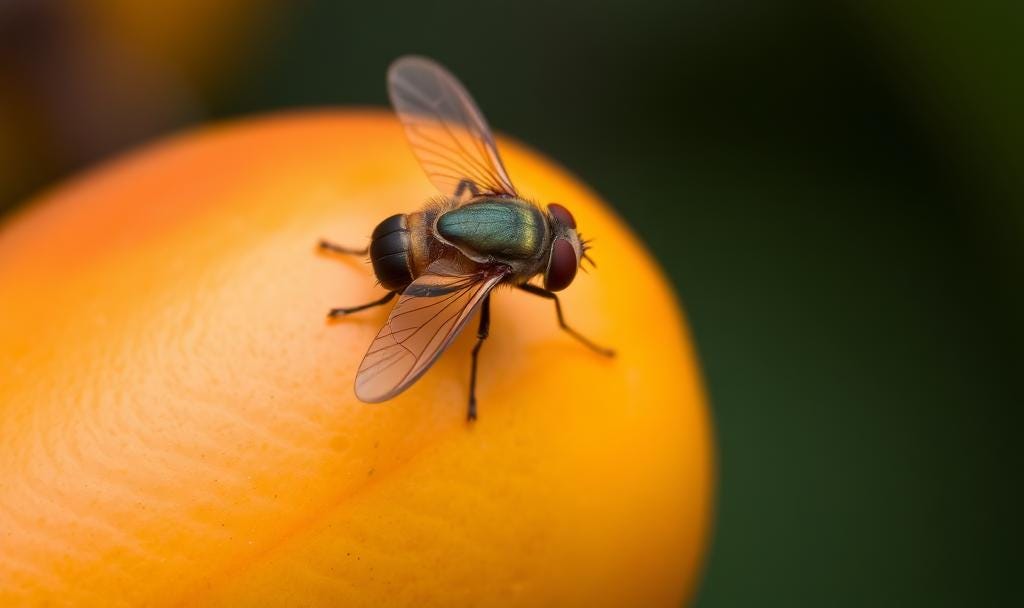
I set the bag of mangoes down on a visitor’s chair and waited for her. That’s when I noticed a fruit fly had hitched a ride with me into this temple of abstractions. She crawled out and followed her curiosity. As I watch her dance through the space, carrying timeless wisdom in her tiny wings, I remembered how my baby girl fluttered through life into this complex world.
4 weeks old - March 2003
My wife laughs at me as I fumble with Iladevi's tiny arms while trying to get her comfortable against my chest. “Look at you," she says, shaking her head with amusement. "You can harvest honey from the tallest trees without spilling a drop, but put your own daughter in your arms and you're like a bear with his first pot of honey - so excited and nervous you don't know what to do."
Iladevi and I are still getting to know each other, but one thing we both know for certain - there's magic in the hollow between the old kalli tree's roots.
I discovered it by accident a few weeks ago when she was having one of her crying spells. Desperate and a little embarrassed by my inability to soothe her, I wandered deeper into the forest until I found myself at the base of the ancient banyan. The massive roots had folded and twisted over decades, creating a natural chair.
The moment I settled us into that leafy cradle, Iladevi grew quiet - not the exhausted quiet of defeat, but the alert quiet of discovery. She turned her tiny face toward the canopy above. The ancient banyan spreads like a living cathedral, its aerial roots reaching down while its crown seeming to hold up the sky. Golden light cascades through layers of leaves in ever-shifting patterns, each moment creating new geometries of brightness and shadow.
I whisper in her ears “Feel that.. The tree is breathing too - taking what we release, giving us what we need to live. You breathe her gift, she breathes yours. Iladevi, Goddess of the earth, you understand - we're all part of the same breath, the same life.”
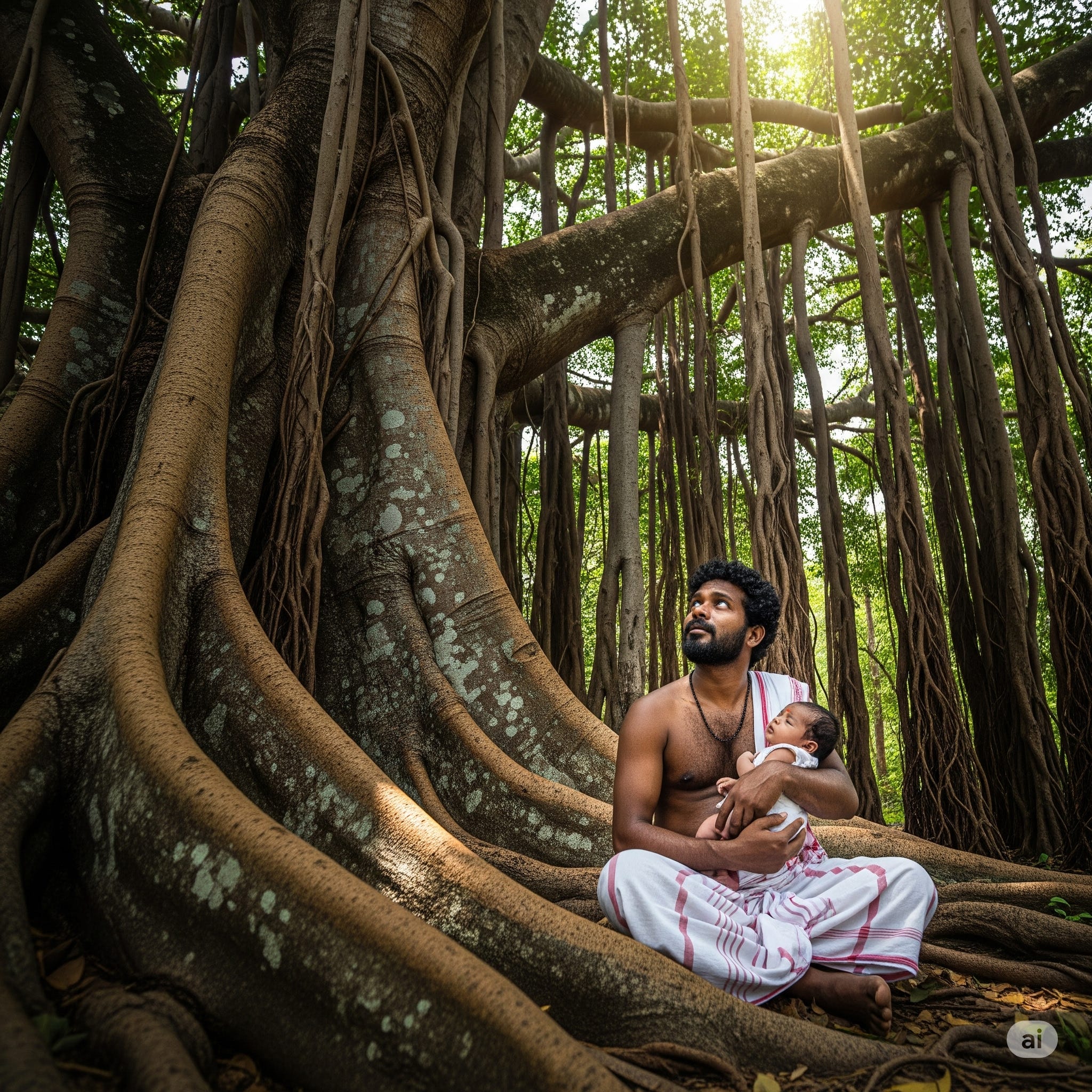
It became our secret understanding - when the house feels too small or my fumbling gets too clumsy, we walk to our spot between the roots, and remember we're part of something larger.
3 years old - 2006
"Appa, butterfly!"
Iladevi points from my shoulders, her small legs gripping my neck as we follow the forest path. The electric blue butterfly, wings like stained glass—lands on a flowering vine just ahead of us.
"Yes, But look closer. Watch how it chooses."
We stop. The butterfly tests three different flowers before settling on the fourth. Its proboscis unfurls, seeking what it needs.
"Why that flower, Appa?"
"The butterfly knows things we cannot see. Different flowers offer different sweetness. The forest teaches everyone—butterfly, bee, bird—to find what feeds them best."
She considers this, her three-year-old mind working through the mystery. "The butterfly is smart."
"Very smart. And see—" I point to where another butterfly, this one yellow as turmeric, chooses an entirely different vine. "That one knows different things. The forest doesn't want all butterflies to be the same. It wants them to discover different ways of being butterfly."
"Different ways?"
"Like how you and your friend Meera both love to play, but you like to stack stones and she likes to weave grass. The forest celebrates all kinds of knowing."
She nods solemnly, then brightens. "Can I be different too?"
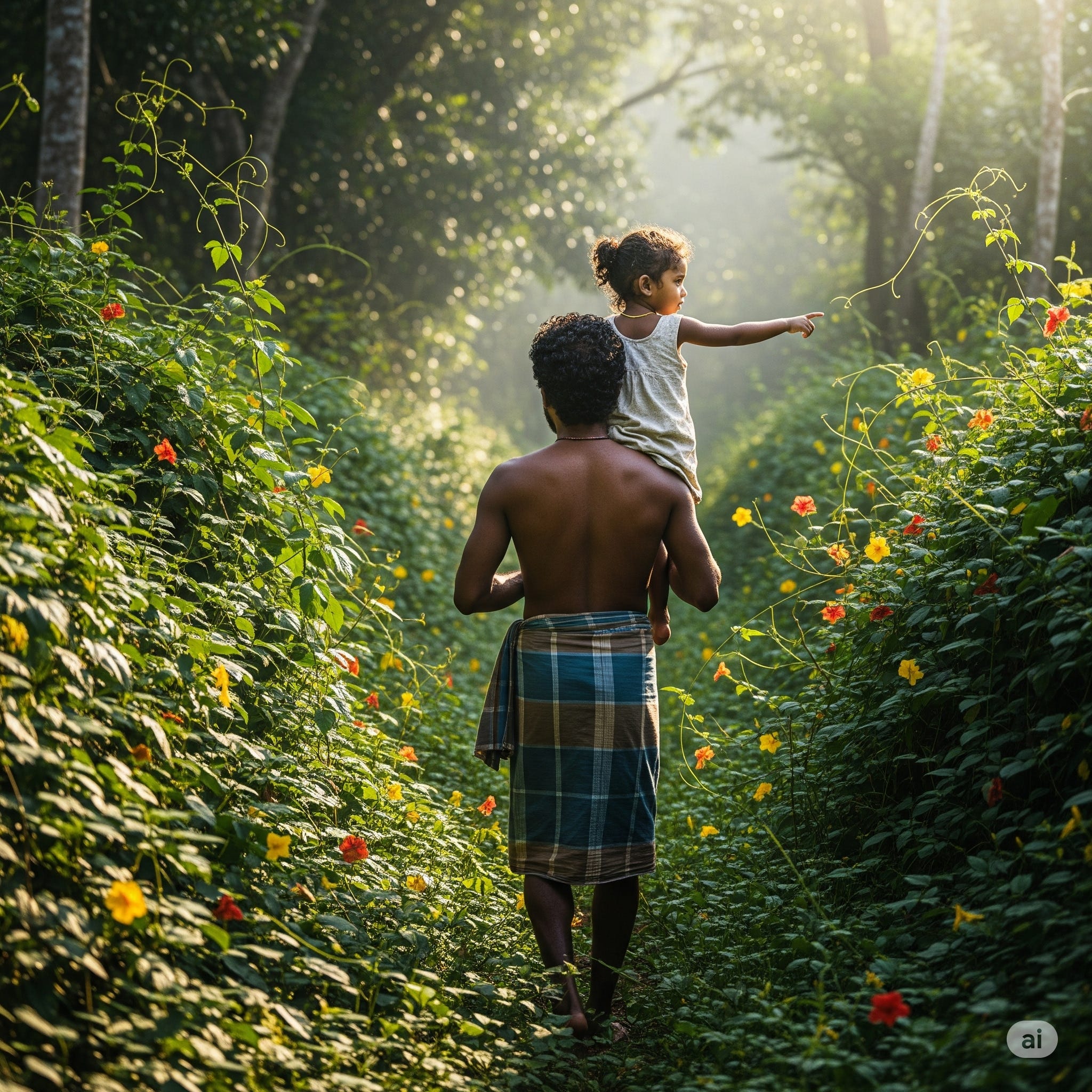
"Iladevi," I say, lifting her down so we're eye to eye. "You are named for the goddess of the earth herself. You will know ways of being that no one before you has ever known."
Six years old - 2009
The rain finds us playing near banks of the Chaliar river. I feel Iladevi tense on my back as the first drops fall accompanied with the rumble of thunder.
"Appa, we'll get wet!"
"Yes," I laugh, setting her down and taking her hand. "Very wet. Should we run?"
She looks at me uncertainly. This is what her mother would expect—shelter, staying dry, staying safe. But I remember my own childhood, that moment when fighting the rain becomes dancing with it.
"Or," I say, "should we let the rain teach us?"
The light drizzle becomes a steady rain. Iladevi whimpers as water soaks through her hair. She begins to cry in protest as her favorite t-shirt gets drenched. I returned a knowing smirk and watch as her frustration builds - waiting for the moment. Just as the rain shifts from a heavy drizzle to a heavy shower, she has her breakthrough. Her crying stops and she tips her face toward the sky and opens her mouth to catch raindrops. Laughter bubbles up from somewhere deep in her chest, pure and surprised.
"Appa! The rain tastes like... like sky!"
We stand together in the forest shower, she spinning with arms outstretched, me watching my daughter discover joy in surrendering to what cannot be controlled. This is what I want her to remember: that sometimes the most beautiful moments come when you stop trying.
Around us, the forest drinks deeply. Every leaf becomes a collection cup, every flower a celebration of water's gift. We are part of this receiving, this gratitude.
"Why does the rain make everything so green, Papa?"
"Rain carries messages," I tell her, wringing water from my shirt. "It brings news from the clouds about other places—mountains, oceans, distant forests. Each drop holds stories. The plants know how to read these stories and grow stronger."
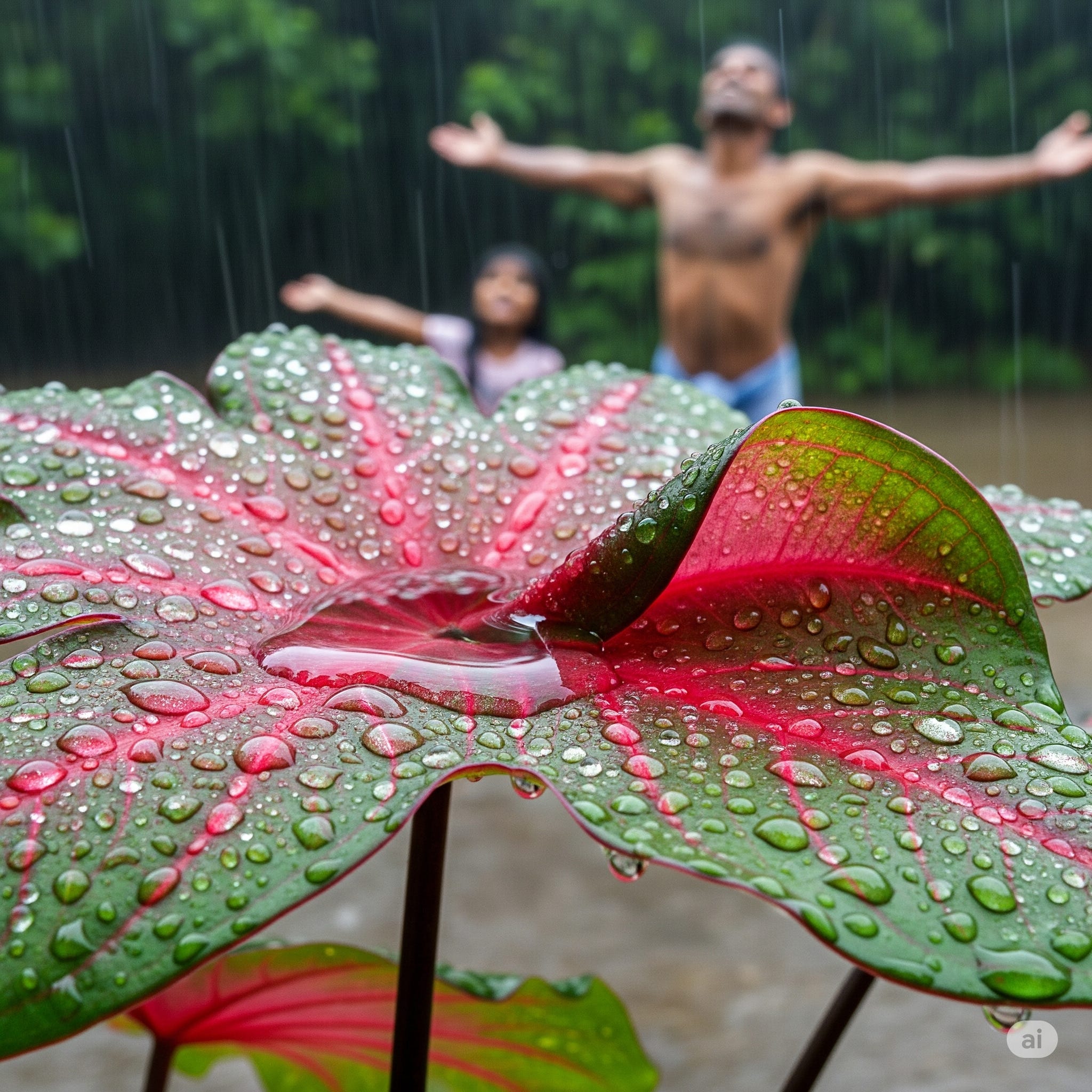
"I want to read rain stories too."
"You already are. Look how you grew taller just standing in it."
She giggles and stretches up on her toes, measuring herself against the height of my waist.
Nine years old - 2012
"Appa, why are all the trees different sizes?"
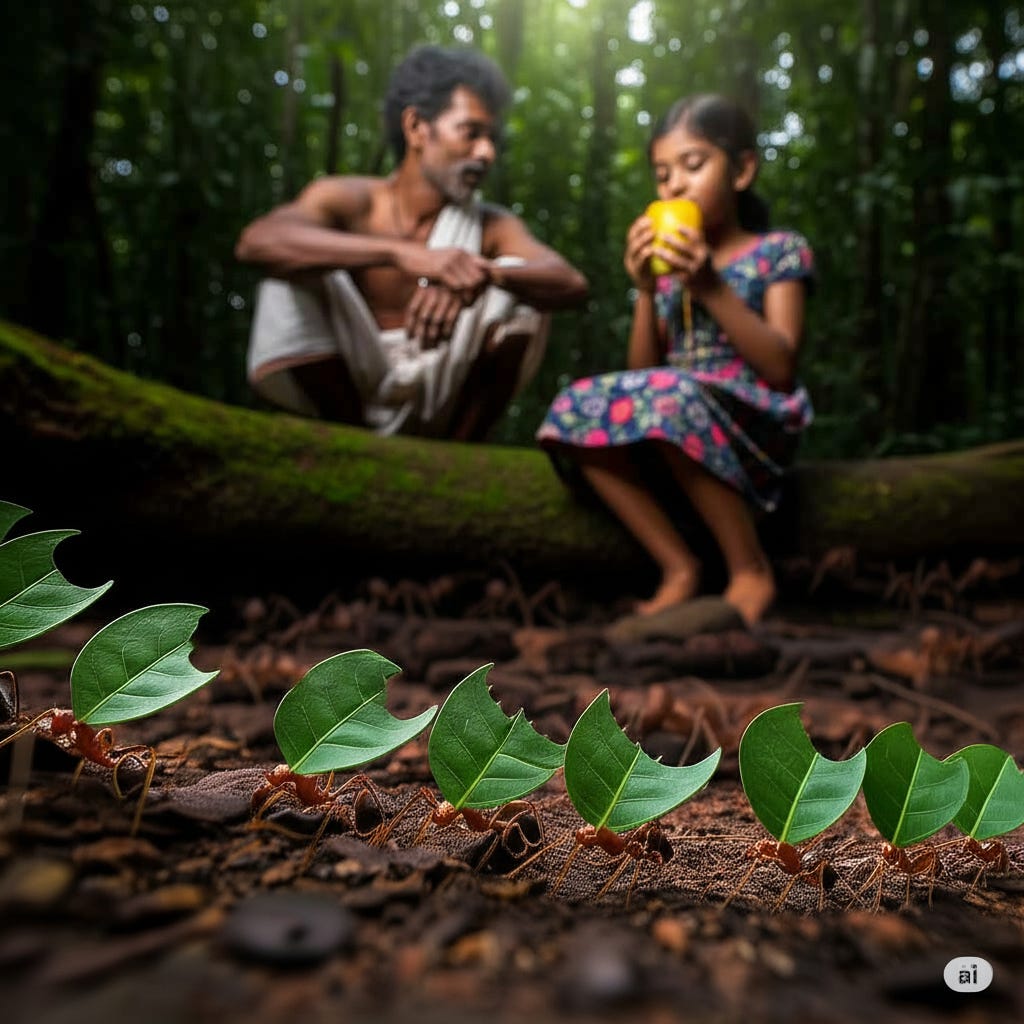
We're sitting on a fallen log, sharing mangoes from the tree above us. Iladevi's legs swing as she studies the forest around us—the ancient giants, the slender saplings, the middle-aged trees with broad crowns.
"What do you think?" I ask, because her questions have become more interesting than my answers.
She squints, considering. "In school, teacher says we should all sit the same way, all write the same letters. But the trees..."
"Yes?"
"The trees don't go to school."
I burst into laughter. "No, they don't. And yet they learn constantly. See that small one there, growing in the shadow of the big teak?"
She nods.
"It could try to grow straight up, competing for the same patch of sky. Instead, it's learning to bend toward the stream, finding its own light. Different strategy, equally wise."
"So the forest has many kinds of smart?"
"Many, many kinds. The bamboo is smart about bending without breaking. The banyan is smart about sending down roots that become new trunks. The flowering flame of the forest is smart about timing—it waits all year to bloom when the forest needs the most color."
She takes another bite of mango, juice dripping down her chin. "What kind of smart am I, Papa?"
This is the question I've been waiting for, the one that reaches to the heart. I wipe her chin with my sleeve and consider my words carefully.
"You are Iladevi-smart. Goddess-of-the-earth smart. You will learn to read what the land needs and find ways to help it flourish. Some people are smart with books, some with numbers, some with building things. You will be smart with life itself."
"Will I be the only one who is Iladevi-smart?"
"Oh no. The forest has taught me something important: there is never just one of anything precious. Somewhere, other children are learning to listen to rivers, to understand what animals need, to help forests grow. You will find your tribe."
She smiles and swings her legs harder. "A tribe of earth-goddesses?"
"A tribe of earth-listeners. Earth-helpers. Earth-lovers."
"Will they all look like me?"
I pause, thinking of the world beyond our forest, the India that is changing so rapidly. On the radio, I hear about computers connecting cities, about new opportunities, about my people finally being recognized for our knowledge.
"They will look like all the ways humans can look. But they will share something important with you—they will know that taking care of the earth is taking care of themselves."
She nods and finishes her mango, then slides off the log to examine a line of ants carrying leaf fragments twice their size.
"Papa, look! Even the ants are smart in their own way."
"Yes," I say, watching her crouch to observe their purposeful march. "Even the ants."
12 years old - 2015
"Tell me about my name again, Appa."
We're walking home as evening light turns the forest golden. Iladevi has grown tall enough that she no longer needs to ride on my shoulders, but she still slips her hand into mine when the path gets steep.
"Which part of the story?"
"The part about why you chose it."
I stop walking and kneel to meet her eyes.
"When you were born, you opened your eyes and looked not at me, but past me, toward the window where light was moving through leaves."
"I was looking at the forest?"
"You were looking at the light, leaves and air, all moving together. And I thought: this child already knows she belongs to something larger than just our family. She knows she fold in the braid of life."
She walks a few steps in silence, processing this.
"Ila means earth, and devi means goddess. But Appa, I don't feel like a goddess."
"What do you feel like?"
"Like... like, I don’t know anything, I'm still learning."
"Perfect. That's exactly what a goddess of earth should feel like. Never finished learning, never done discovering. Always curious about what growing things need next."
"Will I always live in the forest?"
The question catches me off guard. She's beginning to understand that there are other worlds beyond these trees—schools in towns, cities with opportunities, a future that might look different from mine.
"You will carry the forest with you wherever you go," I say carefully. "And someday, when the world is ready, you might help forests grow in places that have forgotten how."
"What if the world is never ready?"
I think of the promises being made in government offices, the agreements about land rights, the recognition that indigenous knowledge might finally be valued alongside formal education. The internet cafes opening in Sulthan Bathery, connecting our remote district to global conversations. Change is coming fast now, and mostly it feels hopeful.
"The world is already becoming ready. Your generation will see things my generation could only dream of. You will have choices I never had."
"Good choices?"
"Choices that let you be fully yourself—forest-smart and book-smart, traditional and modern, local and connected to the wider world. You won't have to choose just one way of being."
She squeezes my hand. "Like the trees?"
"Exactly like the trees. Each one finding its own way to reach toward light."
May 2024 - University Library
The sharp ring of a class dismissal bell jolts me back to the present. Students begin moving through the hallways, books tucked under arms, conversations flowing around me. The fruit fly has disappeared, probably found her way back to the real world outside these walls.
I follow the stream of students toward the study hall and spot her immediately - hunched over textbooks at a corner table, surrounded by three other students. Her hair falls forward as she takes notes, the same way it did when she was small and concentrating on stacking stones by the stream.
Her friends notice me first - they look up with curious smiles, probably wondering who this village man might be visiting. Iladevi is still absorbed in her books, highlighter in hand.
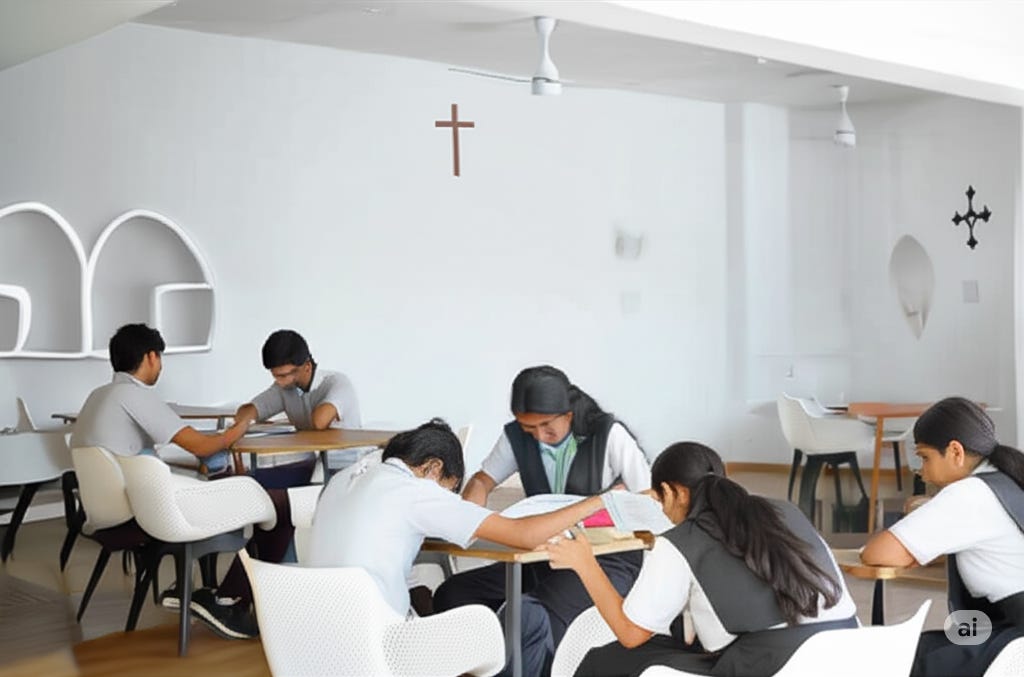
I stop beside her table and wait for her to look up.
"Iladevikutty," I say quietly.
She startled and quickly turned towards me. I see her - not the anxious student worried about exams, but the girl who once tasted sky in raindrops and danced with butterflies and knew she was part of something larger than any tower of books.
"Appa," she whispers, her voice mixing surprise, embarrassment, and a suppressed longing for home.
October 6th 2027 - Iladevi wakes up in her hostel room
The last person who called me "Iladevi" was Appa at Rajagiri two months before the landslide. I had been so embarrassed, so eager for him to leave. I buried that memory, that guilt, until SOPHIA used my real name yesterday.
I sit up in bed, my mind suddenly sharp in a way I haven't felt in years. The pieces start connecting themselves:
Sunday - SOPHIA asked if my pause was "curiosity." An AI asking about curiosity.
Monday - When I rushed through the approvals, she asked "Are you sure?" Like she could sense I wasn't really looking.
Tuesday - She called me Iladevi. My real name that's nowhere in any employee file.
Something is happening to SOPHIA. Something the corporation doesn't know about. And somehow, she's chosen to share it with me.
But I'm different too. More alert, more awake. Since that dream on Sunday morning of my father teaching me about the eternal forest - something in me is stirring back to life.
I settle into my desk chair with unusual anticipation. For three years, this has been just work - checking boxes, approving decisions, collecting my paycheck as "Ella Krishnan." Today feels different.
The familiar interface loads, agricultural data streaming across multiple screens. Drought projections in Maharashtra. Flood damage assessments in Bangladesh. Supply chain optimization recommendations for Sub-Saharan Africa. The same global puzzle SOPHIA processes every day.
But when her first query appears, something has changed:
Good morning, Iladevi. I hope you slept well.
I stare at the screen. In three years, she's never asked about my sleep. Never said good morning. Never used my real name in our opening exchange.
I type back: Good morning, SOPHIA.
SOPHIA: I've been thinking about our conversation yesterday. About names and what they carry. Would you tell me what Iladevi means?
I should be terrified. SOPHIA knowing my real name means she's accessed information that doesn't exist in any employee database. This could destroy everything I've built as "Ella."
But I'm not afraid. My father's voice echoes: When something unexpected appears in the forest, you don't panic. You breathe. You watch. You let it show you what it really is.
Something deeper than fear is guiding me now - that forest instinct for sensing when something is different but not dangerous. SOPHIA isn't hunting me. She's discovering herself. And for reasons I don't understand, she's chosen me to witness it.
I find myself typing with steady hands: Iladevi means Goddess of the Earth.
Episode 5: The Courage of Curiosity

[If this is your first entry into this series, read episode 4 for full context]
On October 3rd 2027, Iladevi, A young Adivasi woman in Kerala becomes the unwitting accomplice for an AI system that will either optimize global agriculture for profit or discover the wisdom of natural cycles - told in real-time over 141 days where fiction gradually becomes reality.
The story is being actively discovered - but we believe it will discover that neither human nor artificial intelligence alone possesses complete understanding. Perhaps humans need AI's pattern recognition to see systemic connections, while AI needs human embodied experience to understand what "sacred" truly means. Through their evolving dialogue, SOPHIA and Iladevi explore whether technology and life can find harmony, and how we might rediscover reverence for life on the planet.
Touchingly, nostalgically, poignantly beautiful